For your master’s degree, you prepared the critical edition of La spiaggia, which Pavese called a “romanzetto” (a “little novel”), not “a fragment of the monolith” representing the thematic core of his fiction. Which results did your research lead to?
My study of Pavese’s archive led to my thesis, “‘Non è scheggia del monolito’. Edizione critica de La spiaggia di Cesare Pavese”, in which I reconstructed the genesis of the novel through the manuscript, the typescript and other preparatory materials (I published part of this research in a 2024 article in Sinestesie online). The starting point of my research was precisely Pavese’s own definition of La spiaggia as a “frank search for style”: the manuscript, the typescript and other witnesses discarded from the final project put to the test the harsh judgment Pavese passed on his “little novel, neither brutal, nor proletarian, nor American”, as he defined it.
We should not forget, in fact, that La spiaggia, despite being the fourth and last of his short novels (written between November 6th, 1940, and January 18th, 1941), was the second to be published, first in a magazine and then in book form, shortly after his debut as a novelist with Paesi tuoi. What first suggests a different assessment is his correspondence with Giambattista Vicari (recently published in the Filari series of the Centro Studi Gozzano-Pavese), editor and publisher of Lettere d’oggi [the magazine in which Pavese published some chapters of the novel, and later the publishing house that printed its first edition, ndr]. This exchange bears witness to the meticulous care with which Pavese followed every stage of publication, intervening on the style, the proofs, the layout, the cover, and even the publishing contract.
Above all, however, it is the examination of the archival papers and their variants – largely substitutive, more rarely alternative – that allows us to get to the heart of that “search for style”, which was anything but marginal in the construction of the writer’s “monolith”. These materials show that Pavese constantly reworked the text, lightening both vocabulary and syntax and cutting overly narrative dialogues and descriptions so as not to fall into “those procedures that Flaubert called ‘the masked balls of the imagination'”, typical of French naturalism, as Pautasso pointed out. Years later, it would again be Pavese himself who noticed the “unifying thread” running through his works when, on March 23rd, 1949, having begun writing Tra donne sole, he placed La spiaggia in the pages of his journal alongside La bella estate and other “poems about women”, tracing a literary path that leads from naturalism (1938–41) to symbolic reality (1947–49).
After all, as Marziano Guglielminetti observed in his introduction to Tutti i romanzi, La spiaggia “must not be considered a mishap along the way”: on the contrary, it shows that “the technique of the ‘image-story’,” typical of Pavese, retains a symbolic value of its own even where its archetypical elements of “the ‘clumsy’ and the ‘breast’ are handled by those who belong to the ‘civilized’ world,” that is, the group of bourgeois characters portrayed during a vacation in Liguria.
Your PhD project is titled “‘I Buy as Many Books as I Can’: A Digital Catalogue of Pavese’s Marginalia.” How will digital technology contribute to your study?
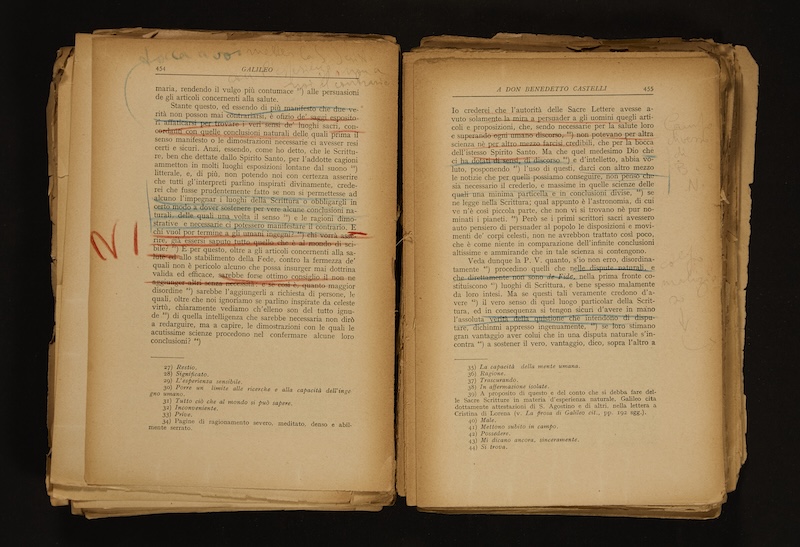
It will not simply be a medium onto which the results of the research are transferred and presented, but a tool that will, above all, serve a methodological function. There are several possibilities in this respect, and an important part of my PhD project will consist precisely in assessing which solutions are the most effective, both from a scholarly point of view and in terms of user experience. A digital catalog capable of integrating the author’s annotated books with archival papers raises questions that concern not only the preservation and accessibility of the materials, but also the ways in which they can be queried. A first step in this direction has already been taken thanks to funding from the Soprintendenza Archivistica e Bibliografica del Piemonte e della Valle d’Aosta (the Archival and Bibliographic Superintendency of Piedmont and Aosta Valley), as part of a very recent project that has made it possible to recatalog the entire book collection, alongside the digitization and restoration of some of Pavese’s volumes.
What opportunities, but also what risks, come from the retrospective study of marginalia, which are the notes Pavese left on the pages of the books he read?
A writer’s library is a privileged tool of inquiry, because it allows us to enter their workshop from a new perspective, complementary to the one offered by the manuscripts of their works. A marginal note, on the other hand, is a very generic witness of its author’s perspectives: it establishes a dynamic, dialogic relationship with the text from which it originates, in order to comment on it, explain it, contest it or, as in Pavese’s case, translate it (I am thinking of North American literature as well as Latin and Greek literature). But it may also refer to other annotations in the same volume, to other books or to different archival materials. The study of Pavese’s books, held at the aforementioned Centro Studi, must therefore start from a reconstruction of the context of those readings, bringing out, on the one hand, Pavese’s relationship with the culture of his time and, on the other, the dense connections between reading and creative activity, by cross-referencing the annotated books with the evidence scattered throughout Il mestiere di vivere, the Lettere, his literary essays, his novels, the editorial reports he wrote for Einaudi and some still-unpublished archival materials. If we want to speak of risks, beyond problems of attribution (the shelves also hold some “extraneous” books), the danger is that of isolating a marginal note from its context, limiting its interpretation to the single page on which it is written.
Pavese considered himself so much a man of letters that he called himself a “book man”, and yet for years critics focused on biographical elements that had nothing to do with his books. On the other hand, a purely philological approach would leave out other important aspects. How can we balance these two perspectives to define a fruitful line of Pavese research for the future?
Rather than balance, I would speak of integration. Philology is an indispensable tool, all the more so when one works on archival papers or, in my specific case, on authors’ annotated books, but it can never be an end in itself: it must be put at the service of interpretation. Obviously, the philological evidence is the starting point, but it is when we relate it to the rest of the author’s work that it can become a tool for understanding that work better, for discovering unexplored sides of it and, at times, for calling established readings into question. A variant, a marginal note or an underlining acquires critical value when we manage to examine it within a network of relationships and to understand whether, and in what form, what it documents then finds its way into the writing. After all, for years we believed we knew Pavese thoroughly, but it was precisely the critical editions of his works that showed us how, in reality, we had understood him only in part.
“Un Pavese ci vuole”: this misquotation from a very famous passage from The Moon and The Bonfires was the title of a series of video-interviews I conducted with the director of Fondazione Pavese, Pierluigi Vaccaneo. Seventy-six years after Pavese’s suicide, do we still need him? And, whether yes or no, why?
First of all, I think a clarification is needed: in Pavese’s case, it is impossible to separate the man from the man of letters. Indeed, Pavese is first and foremost a man of letters, and within the man of letters there is inevitably also the man who spends his whole life searching for answers, which he finds precisely in literature. He is an author who constantly questions himself, who cultivates doubt, in his diary as much as in his novels; and at a present time, when there is less and less room for uncertainty and complexity, a time when we constantly feel the need to have clear-cut, definitive answers at hand, we definitely still need “un Pavese”. I believe this is one of the reasons for his strength and vitality, and it is also why he continues to be much loved by young people, who, beyond the few lines in their school anthologies, keep reading him and feeling close to him. After all, Pavese never shied away from examining his conscience – just think of the self-assessments in Il mestiere di vivere – and he invites others to do the same. And this tendency to confront the fragility of human experience to the very end, without simplifications or resignation, makes his voice more alive than ever.
An interview by Iuri Moscardi
>> Read the other Dialogues with Pavese
 Eleonora Gatto is a PhD candidate in Italian Literature at the University of Turin. Her research project, “«Io compero quanti più libri posso». Per un catalogo digitale delle postille d’autore pavesiane” (“«I Buy as Many Books as I Can»: A Digital Catalogue of Pavese’s Marginalia”; supervisor: Professor Laura Nay), aims to catalog and study the library of the writer (some preliminary results have been published in a 2026 academic article and presented at the 2025 conference of MOD, the Italian Society for the Study of Literary Modernity). Her research interests include 20th-century Italian literature, authorial philology, archives (in particular those of Cesare Pavese, held at Centro Studi Interuniversitario Guido Gozzano-Cesare Pavese in Turin) and Digital Humanities. Her focus on the DH opportunities for the study and promotion of archives led her to collaborate on the PRIN 2022 project “PAVES-e. Per un’edizione-archivio digitale dell’opera di Pavese” (“PAVES-e: A Digital Archive-Edition of Pavese’s Works”), about which we interviewed Professor Antonio Sichera a few months ago. Here, we asked her to present her research.